Dodge Dart 2013-2016 pros and cons, common problems
By Vlad Samarin Updated: February 04, 2023
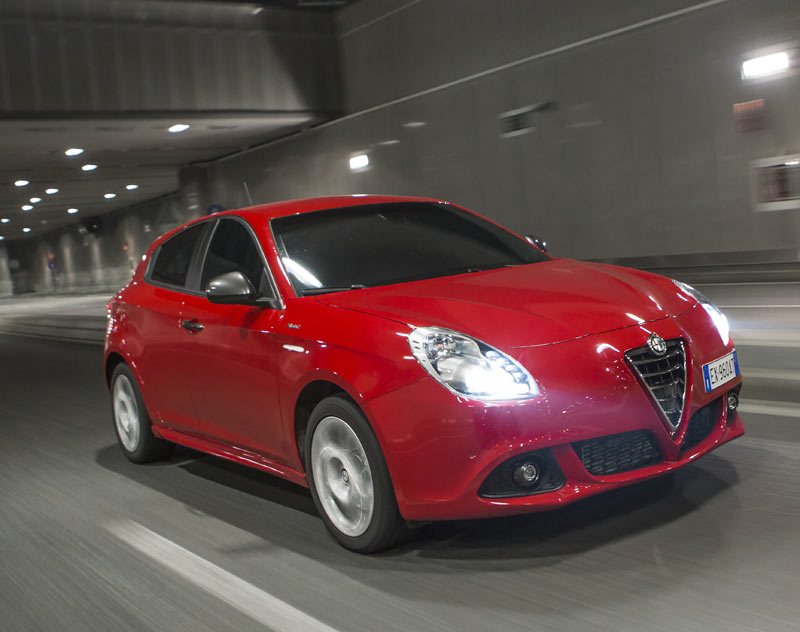
Discontinued after 2016, this sporty compact is now rare and unique. Based on the expanded Alfa Romeo Giulietta platform, the Dart offers an American style with European handling. Compared to other compacts, the Dart is wider and heavier.
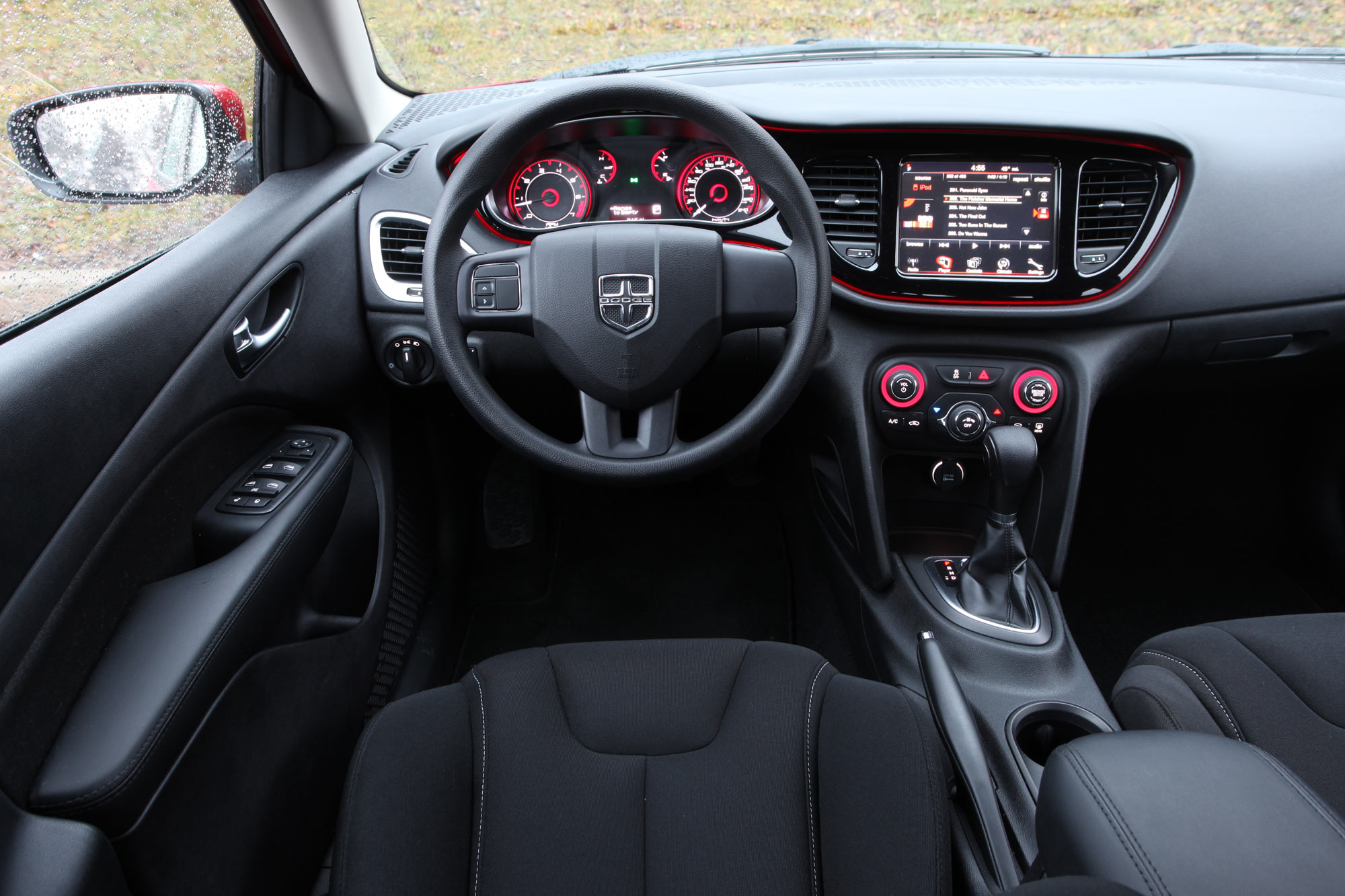 Dodge Dart 2013 interior.
 Click photo for larger image
The interior space is almost like in a mid-size car. The Dart feels solid and stable on the road. That's all good, but is it reliable? What are the common problems?
Pros:
- Awesome exterior styling.
- Sense of exclusivity. It's a rare sporty compact car.
- Good handling, pleasant ride.
- Dash design, interior spaciousness.
- Uconnect infotainment system with the 8.4" display.
- Top safety ratings.
- Engine and transmission issues.
- Parts may be difficult to find.
- Low trade-in value.
- Fuel economy could be better.
Failed thermostat: The Check Engine light with the trouble code P0128 is often caused by a bad thermostat. Often the Check Engine light keeps coming on and off when the weather gets colder. Replacing a thermostat at a dealership may cost from $320 to $410. The engine computer (PCM) software may need to be updated too.
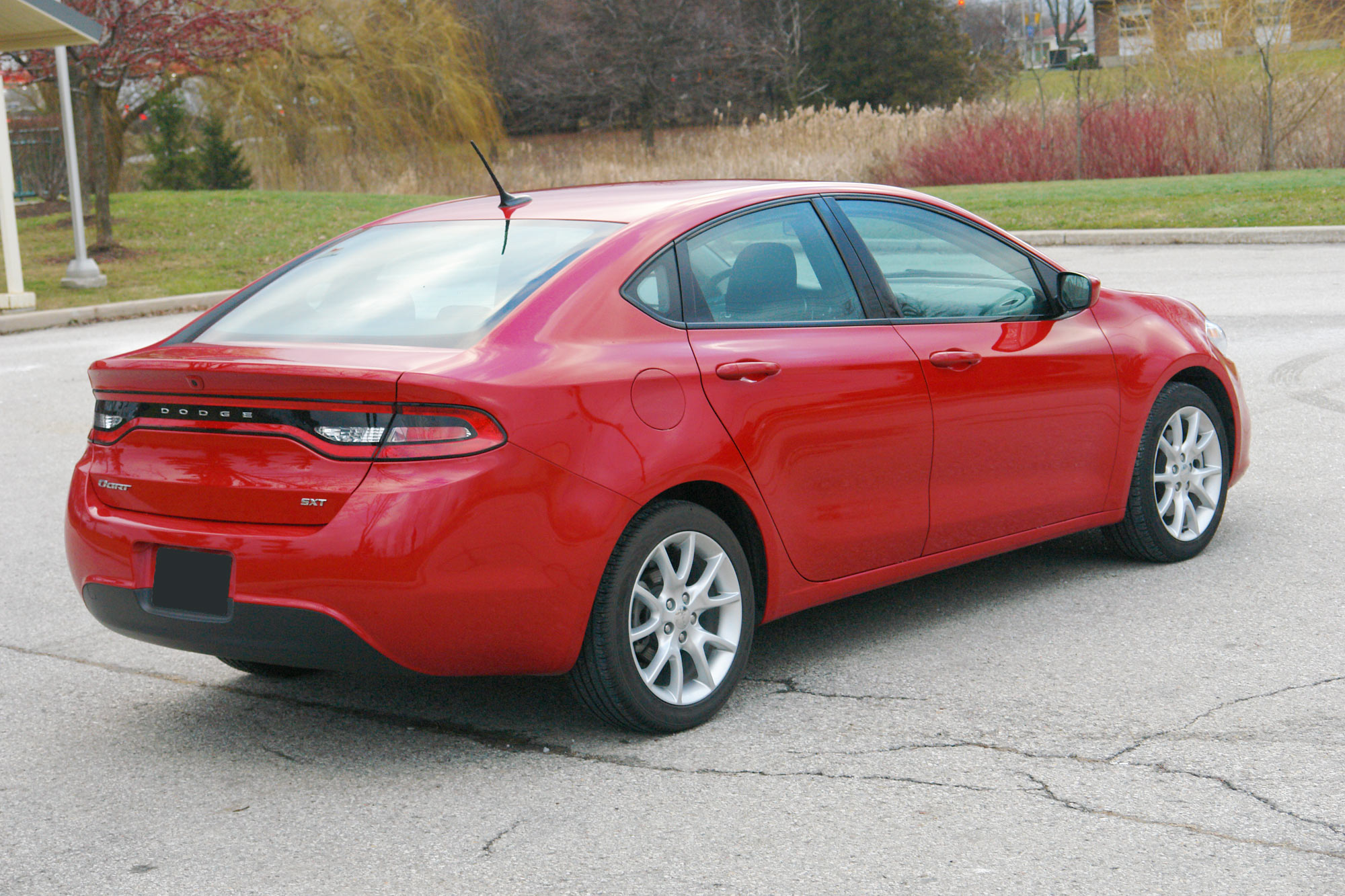 2013 Dodge Dart.
 Click photo for larger image
Oil pressure sensor: TSB 18-034-14 REV. A recommends replacing the oil pressure sensor when the trouble code P0520 - Engine Oil Pressure Sensor Circuit is set in the 2013-2014 Dart. The oil pressure sensor (switch) is not very expensive.
Cooling system problems: There are a number of reports of the engine overheating, especially with the 2.0L engine. There are several possible reasons for the engine to overheat. One of the reasons is a lack of coolant due to a leak. The heater hose is one of the common sources of the leak. Considering this, it's a good idea to check the coolant level regularly and if a leak is suspected, to repair it before it can cause overheating.
The FCA service bulletin (TSB) 18-023-16 REV. C for the 2013-2015 Dart recommends reprogramming the PCM to address several Check Engine light codes in the 2.4L engine.
Many owners mentioned oil consumption issues in the 2.4L Multiair engine. In some cars, the entire engine has been replaced during the warranty period. It's a good idea to regularly check the oil level as running the engine low on oil can cause problems. Excessive oil consumption is very common in many modern cars.
Advertisement
There have been complaints about problems with the clutch in a manual transmission or an automatic transmission failing.
FCA has issued several updates for the Uconnect software to fix various glitches. Read more at DriveUconnect.com. We found reports that hard-resetting the system by disconnecting the battery eliminates some of the glitches. Several recalls have been issued for Dodge Dart; check on the NHTSA website.
Summary:
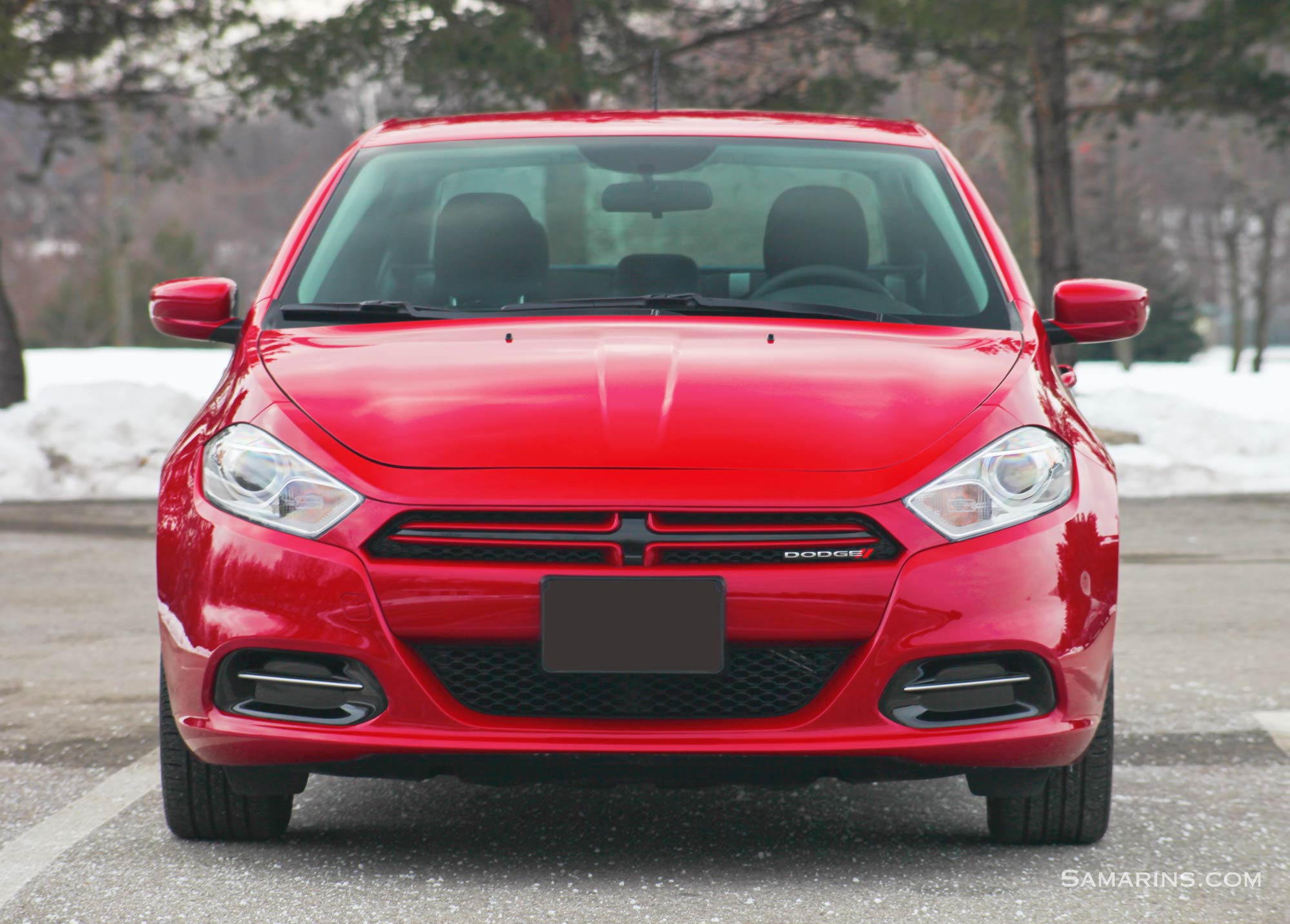 2013 Dodge Dart.
 Click photo for larger image
The huge 8.4" Uconnect touchscreen is unique to the compact car class. The optional navigation is easy to operate. Plus, exclusivity is always worth more, now that the Dart has been discontinued. On the downside, it's not the most reliable car and will need repairs here and there. Parts are not always available.
We recommend avoiding the turbo engine and the dual-clutch transmission. Both are more likely to have problems. If you are buying a used Dodge Dart, consider an extended warranty that will cover repair costs. If you want a more reliable sporty compact car, consider the Honda Civic or Mazda 3.
Engine: Three 4-cylinder engines are available: the base 160-hp 2.0-liter DOHC Tigershark is standard on SE, SXT, Rallye and Limited.
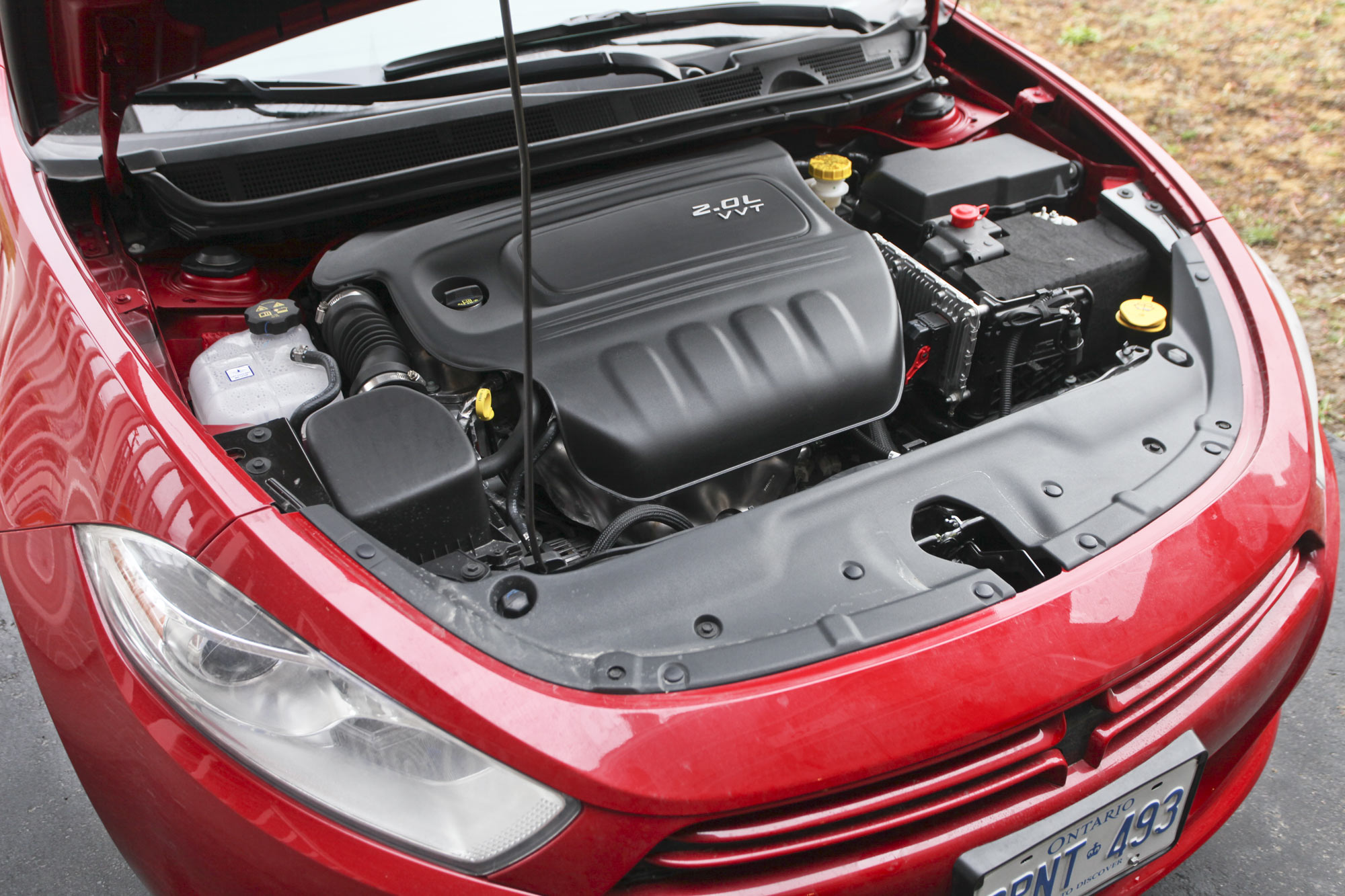 Dodge Dart 2013 2.0L engine.
 Click photo for larger image
For buyers looking for fuel efficiency, there is an optional 160-hp 1.4L MultiAir intercooled turbocharged motor available on SE, SXT, Rallye and Limited. It comes with either a 6-speed manual or a 6-speed dual dry clutch automated manual transmission.
The Dodge Dart GT is fitted with a 184-hp 2.4-liter MultiAir 2 Tigershark engine. Read also: Pros and cons of turbo engines.
Timing belt or Timing chain: The 1.4L turbo engine has a timing belt that, according to the 2013 Dart owner's manual, needs to be replaced every 150,000 miles or 240,000 km. Both the 2.0L and 2.4L engines have a timing chain.
Mechanical: The Dart has MacPherson struts in the front and European-styled bi-link independent rear suspension. The steering is electrically assisted.
Fuel Economy: The 2013-2016 Dodge Dart with a 2.0L engine and automatic transmission is rated at 27 mpg combined or 24/33 mpg (9.8/7.1 L/100km) city/highway. This means you can get up to 430 miles (692 km) on one tank of gas. The 1.4L turbo Dart auto with Aero package gets 28 mpg city and 39 mpg highway (8.4/6.0 L/100km). The 2.0L and 2.4L motors can run on regular gasoline. For the 1.4L turbo, premium gasoline is recommended.
| Dodge Dart EPA Fuel Economy: | mpg city/hwy |
L/100 km city/hwy |
| 2013-2016 1.4L Aero manual | 28/39 | 8.4/6.0 |
| 2013-2016 1.4L Aero auto | 29/38 | 8.4/6.2 |
| 2013-2016 1.4L manual | 28/39 | 8.4/6.0 |
| 2013-2016 1.4L auto | 29/38 | 8.4/6.2 |
| 2013-2016 2.0L manual | 25/35 | 9.4/6.7 |
| 2013-2016 2.0L auto | 24/33 | 9.8/7.1 |
| 2014-2016 GT auto | 22/31 | 10.7/7.6 |
| 2013 2.4L auto | 21/30 | 11.2/7.8 |
Toyota Corolla 2009-2013
Toyota Corolla 2014-2018
Mazda 3 2010-2013
Mazda 3 2014-2018
Chevrolet Sonic 2012-2016
Chevrolet Cruze 2011-2015
Honda Civic 2012-2015
What to look for when checking a used Dodge Dart: Regular maintenance is very important, especially for the turbocharged engine. Check the vehicle's service records to verify timely oil changes. A low oil level and a burnt oil smell under the hood could be an indication of excessive oil consumption. In a turbocharged engine, watch out for white smoke or noisy turbocharger. A turbocharger is expensive to replace.
During a test drive, try driving slowly over small bumps to see if the suspension stays quiet. See if the vehicle doesn't pull to one side or the other on the highway.
Maintenance tips: Check the engine oil level regularly and top up as needed; see how to check the engine oil.
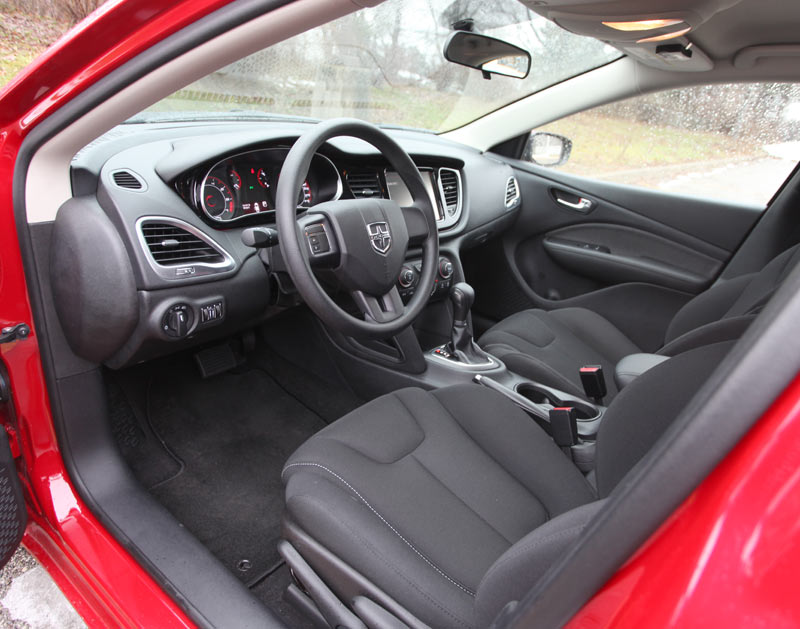 2013 Dodge Dart interior.
 Click photo for larger image
What is the recommended oil change interval? The 2013 owner's manual doesn't specify the interval for regular oil changes. It says that the oil change indicator system will display the message 'Change Oil' automatically; the interval is calculated based on the driving conditions. The oil change indicator needs to be reset after performing the scheduled maintenance. The procedure to reset the oil change indicator is described in your owner's manual (page 297 in the 2013 Dodge Dart OM).
Should the timing belt be replaced earlier than the recommended interval? In our opinion, 150,000 miles is too long; we would recommend replacing it much earlier.

 © Samarins.com 2000–2025. All rights reserved.