Honda CR-V 2002-2006: problems, fuel economy, pros and cons, 4WD system
Updated: January 21, 2020
The second-generation Honda CR-V offers a roomy and functional interior, car-like handling and good fuel economy.
Inside, the CR-V feels surprisingly roomy for a small SUV. A tall driving position provides a commanding view of the road. The instruments are simple and straightforward.
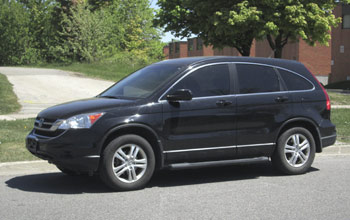
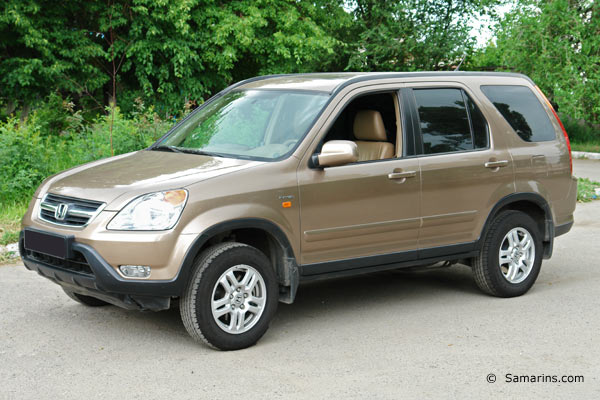 2004 Honda CR-V
Rear seats are adjustable and can be folded forward, offering a huge cargo space (72.0 cu. ft.) in the back. According to Honda, the CR-V can accommodate two fully assembled, full-size mountain bikes. The rear liftgate window opens separately. As in the previous model, there is a foldable picnic table under the floor carpet that also serves as a cover for a large storage in the back.
Honda CR-V Problems: Headlight bulbs fail often, although they are not very expensive to replace. See these YouTube videos on how to replace.
A worn-out stabilizer bar link can cause a knocking noise when driving slowly over small bumps and excessive body roll in turns. Replacing one link will cost $80-$140 in a shop.
The Honda TSB 08-016 says that the Check Engine code P1457 can be caused by the blocked or restricted EVAP solenoid valve (fuel vent module). To correct the problem, Honda advises installing an EVAP solenoid valve kit.
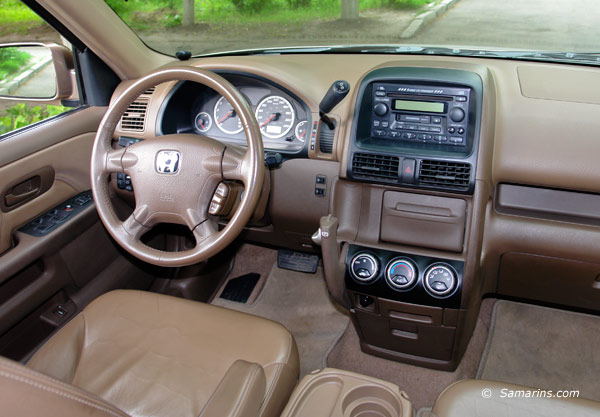 Honda CR-V interior. Click for a larger view
A worn-out U-joint or center support bearing for the drive (propeller) shaft can cause a vibration noticeable at certain speeds. Either part can be replaced separately. It's a $220-$460 repair in a shop.
An A/C compressor can fall apart inside and cause the metal particles to contaminate the whole A/C system. Some parts of the A/C system can be flushed, others will have to be replaced. The repair is expensive, minimum $800-$900.
If one of the engine mounts goes bad, it may cause a vibration in "Drive."
Advertisement
Shuddering from the rear axle at low speed turns might be fixed by changing the fluid in the rear differential, using the Honda recommended "Dual Pump" fluid.
Powertrain: The 2002-2006 CR-V is available as front- or all-wheel drive (only AWD in Canada) with a manual or automatic transmission. The only engine choice is a strong and reliable 160-hp 2.4-liter 4-cylinder DOHC i-VTEC.
Timing belt or chain: The 2.4L K24 engine has a timing chain; there is no timing belt.
Fuel Economy: Honda CR-V is one of the most economical SUVs. The EPA rates the 2005 AWD Honda CR-V with an automatic transmission at 20/25 mpg or 11.8/9.4 liters per 100 km. This means that you can drive for 303 miles (487 km) on one full 15.3-gallon (57.9L) tank of gas.
Mechanical: The CR-V has disc brakes on all four wheels; the ABS is available (standard on all models from 2005).
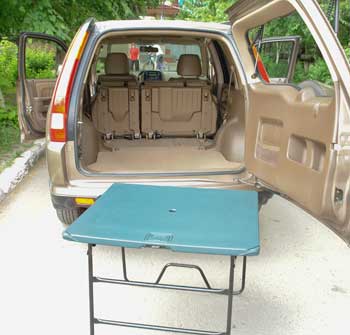 The CR-V comes with a built-in picnic table that also serves as a cover for rear cargo area.
 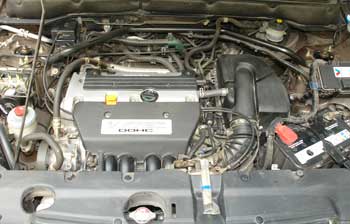 Honda CR-V 2.4L 4-cylinder engine.
 4WD system: The CR-V has a Dual Pump AWD system. In normal conditions, the CR-V is powered by the front wheels. Once front wheels start slipping, the dual pump system built into the rear differential engages the rear axle. It's a simple and effective on-demand AWD system. A noise coming from the rear end at slow turns could be caused by deteriorated rear differential fluid; have it checked. If it needs to be changed, use only original Honda Dual Pump Fluid. According to the 2004 CR-V owners manual, the rear differential capacity is 1.1 US qt or 1.0 l. Changing the rear differential fluid in the shop costs $120-$190.
Handling and Ride: On the road, the CR-V offers almost a car-like handling. The ride is firm but comfortable, although you will hear some road noise. Tight turning radius is great in city driving or parking maneuvers.
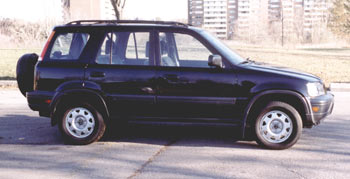
Pros: Fuel economy, visibility, handling, crash test scores, practical spacious interior, cargo space, liftgate window opens separately, tight turning radius, resale value.
Cons: Firm ride, road and engine noise, front seats are not very comfortable on long trips, boxy look.
Overall: The 2002-2006 Honda CR-V is one of the most practical compact SUVs ever built. Add to this a solid engine, simple AWD system and a picnic table and you've got a great little road trip vehicle.
The 2002-2006 CR-V has been reliable for the most part, although some problems, e.g. with the air conditioner compressor, could be quite expensive to repair. As of January 2020, the 2005-2006 Honda CR-V is listed as 'Recommended' at the Consumer Reports website. Toyota RAV4 is a perennial competitor. It's a similar SUV that also offers good fuel economy.
Similar cars:
Used Honda CR-V 2007-2011
Used Toyota RAV4 2001-2005
Used Toyota RAV4 2006-2012
Used Ford Escape 2008-2012
What to look for when buying a used Honda CR-V: If the "Check Engine" light is on, have the problem checked out before buying a vehicle. Check the engine oil level; low oil level could be an indication that the engine consumes oil. In the Rust Belt, watch out for excessive rust underneath. It helps if you can test the AWD system in slippery conditions to make sure that it works. Test the air conditioner. Judging by the number of complaints, it's one of the weak spots; the repair could be expensive. Read our illustrated guide: How to inspect a used car for more tips on what to look for. Before buying a vehicle, have it properly inspected by a mechanic.
Maintenance: Overheating may cause many engine problems; keep the coolant level topped up. Regular oil changes are important to keep the engine in good shape. Winter tires will provide better traction in snow. Change transmission fluid at recommended intervals using original Honda transmission fluid. At least once a year have your vehicle inspected on the lift to keep it safe. Many components (e.g. brakes, steering, suspension) cannot be properly inspected in a drive-through oil change place.
 © Samarins.com 2000–2024. All rights reserved.