Air Fuel Ratio / O2 Sensor: how it works, problems, testing
Updated: September 13, 2021
In the early 00's conventional oxygen sensors gave way to more precise air fuel ratio sensors, although they are still referred to as 'oxygen sensors' or O2 sensors.
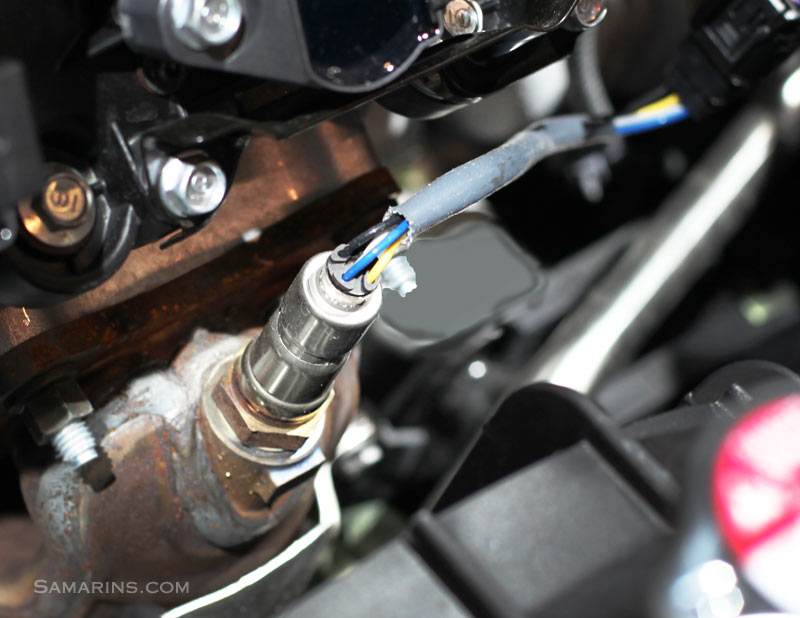 Air fuel (A/F) ratio sensor
The air fuel ratio sensor is installed in the exhaust manifold or in the front exhaust pipe, before the catalytic converter. It might also be called 'front O2 sensor'. The job of the air fuel ratio sensor is to measure the oxygen content in the exhaust and provide feedback to the engine computer (PCM). Based on air fuel ratio sensor signal, the computer adjusts the air to fuel ratio to keep it at the optimum level, which is about 14.7:1 or 14.7 parts of air to 1 part of fuel.
Air fuel ratio sensor problems
Problems with air fuel ratio sensors are common. Often a sensor gets contaminated or simply fails. In some cars, the heating element inside the sensor can stop working and cause the malfunction. For example, in many Toyota and Honda cars the code P0135 may be caused by a failed heating element inside the sensor. See how the heating element of the A/F sensor is checked in this article: code P0135.Most common OBDII trouble codes related to an air fuel ratio sensor are P0131, P0134, P0135, P0133, P0031 and P1135. Are there any symptoms besides the Check Engine light? In some cars you may notice a drop in the fuel economy or some driveability issues.
Air fuel ratio sensor diagnostic
An air fuel ratio sensor is diagnosed following the manufacturer's troubleshooting procedure for the trouble code that has been set. The first step is to check for related technical service bulletins (TSBs). The wiring and the connector of the sensor must be checked for damage, corrosion, loose pins, etc.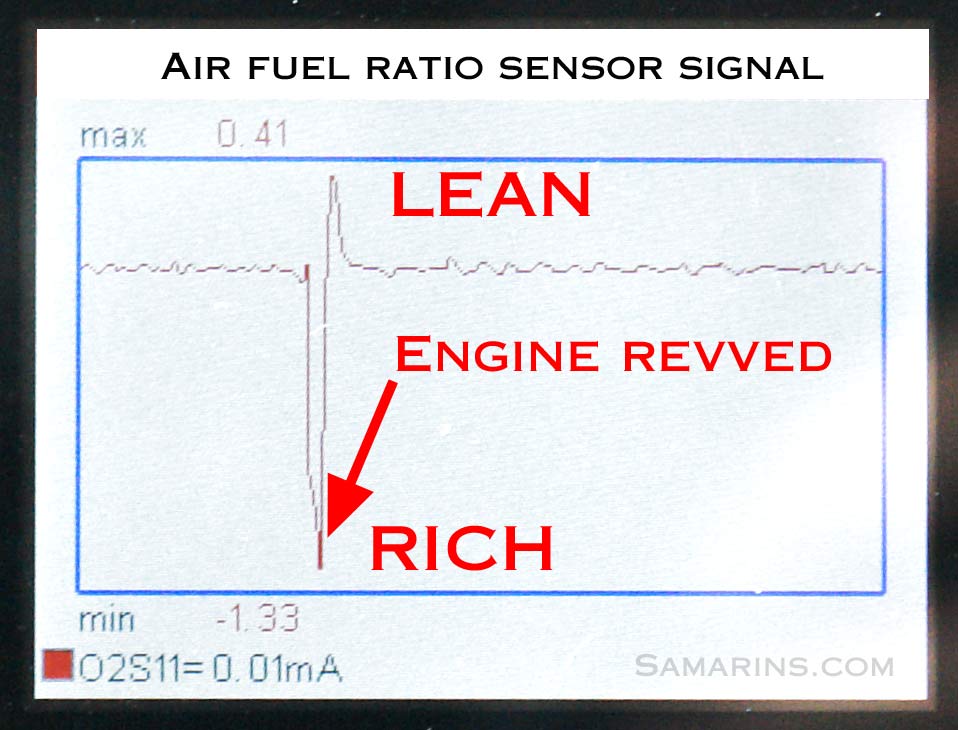 Checking the air fuel ratio sensor with a scan tool.
Often, the sensor may work properly at the time of the inspection. In this case, your mechanic may recommend replacing the air fuel ratio sensor to eliminate the possibility of an intermittent fault.
Rear Oxygen Sensor
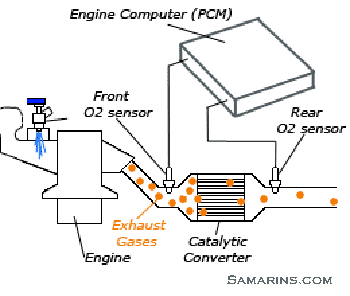 Rear (downstream) oxygen sensor diagram
The engine computer or PCM constantly compares the signals from the front and the rear oxygen sensors (see the diagram). Based on the two signals, the PCM knows how well the catalytic converter does its job. If the catalytic converter fails, the PCM turns on the "Check Engine" light to let you know.
The rear oxygen sensor can be checked with a scan tool or a lab scope.
Air Fuel Ratio/Oxygen Sensor Identification
The front oxygen sensor or air fuel ratio sensor is installed before the catalytic converter; it's called an 'upstream' or 'Sensor 1'.The rear oxygen sensor installed after the catalytic converter is called 'downstream' or Sensor 2.
A typical in-line 4-cylinder engine has only one bank (Bank 1). Therefore, in an in-line 4-cylinder engine, the term "Bank 1, Sensor 1" simply refers to the front oxygen sensor. "Bank 1, Sensor 2" is the rear oxygen sensor.
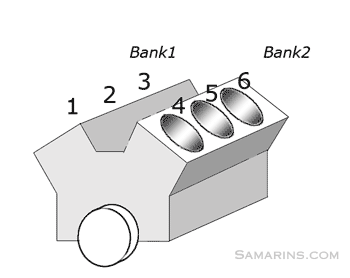 Typically, the engine bank that
 contains cylinder 1 is called Bank 1
The V6 or V8 engine has two banks (or two parts of that "V"). Usually, the bank that contains the cylinder number 1 is called "Bank 1."
Different car manufacturers define Bank 1 and Bank 2 differently. To know which is Bank 1 and Bank 2 in your car, you can look it up in a repair manual or you can google it, mentioning the year, make, model and engine size of your car. For example, according to the Toyota bulletin TSB-0398-09, in a V6 Camry, Highlander, Avalon, Sienna and Solara, bank 1 is at the back, bank 2 is in the front. Similarly, in a V6 2003-2008 Mazda 6 or V6 Mazda Tribute, bank 1 is at the back, bank 2 is at the front. In a 2003 Nissan Maxima, bank 1 is at the back, bank 2 is at the front.
Replacing Air Fuel Ratio/Oxygen Sensor
In most cars, replacing an oxygen sensor is a fairly simple job unless it's difficult to access. In a repair shop, oxygen sensor replacement costs from $50 to $250 (labor only).Advertisement
If you want to replace the oxygen sensor yourself, with some skills and a repair manual, it's not so difficult, but you might need a special oxygen sensor socket (in the photo below).
Sometimes it might be difficult to remove an old sensor, as it could be seized in its thread. We found several videos on how to remove a seized O2 sensor.
When replacing an air fuel sensor there are two options: to install an original (OEM) or aftermarket part. Aftermarket sensors work fine most of the time. However, we came across several cases where an aftermarket sensor was causing the problem that was fixed after installing an OEM sensor.
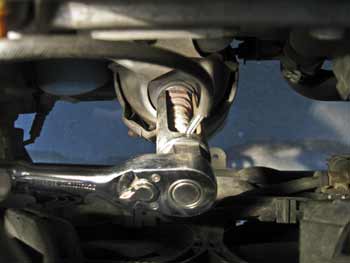 Replacing the oxygen sensor
 For California-certified cars, the part number for the air fuel ratio sensor might be different. It's best to order the correct part using your VIN number.
 © Samarins.com 2000–2025. All rights reserved.