Check Engine Light: What to check first, repair options
By Vlad Samarin. Updated: October 01, 2022
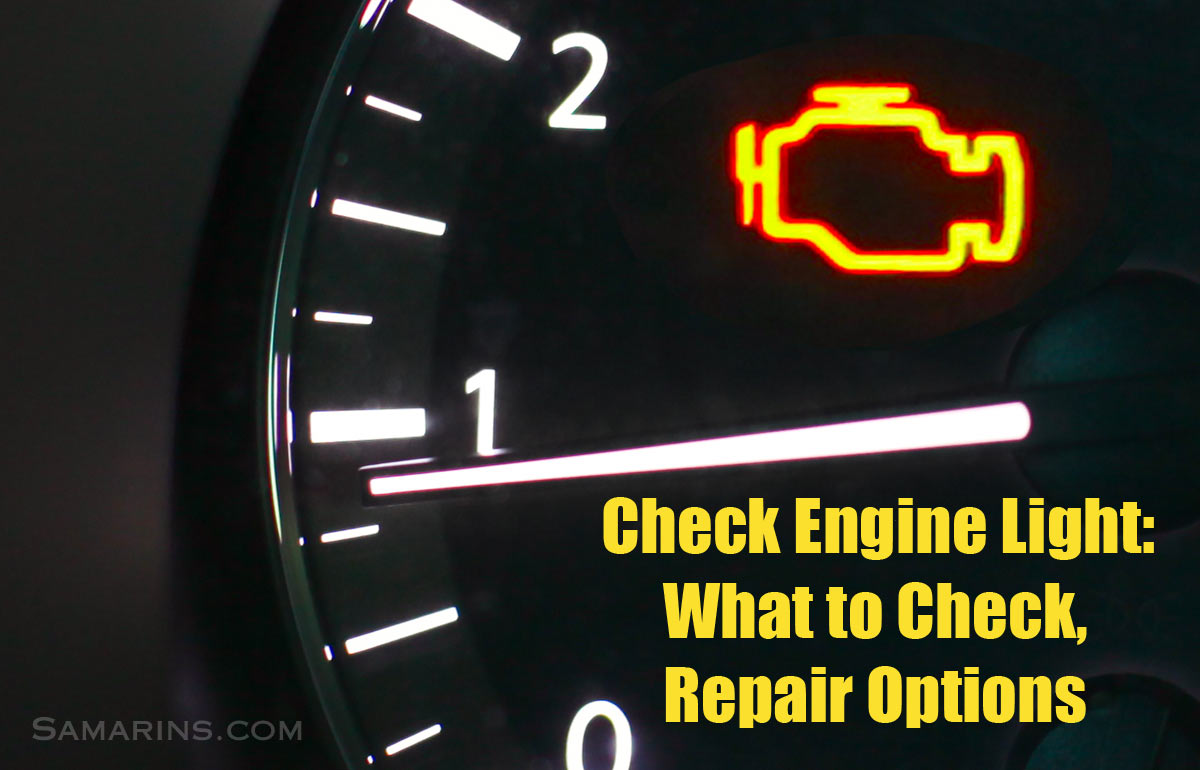 Check Engine light
1. Check the basics, is the gas cap closed properly? Is there enough oil in your engine?Read more about each point below. If you already know the trouble code, we have written about some common trouble codes, select from drop-down menu:
2. Have your vehicle scanned for trouble codes, have the stored code(s) diagnosed and get the repair quote.
3. Consider repair options; It can be costly unless it's covered by the warranty, but there are several ways to save your hard-earned money.
4. Have the problem repaired and the Check Engine light reset.
What needs to be checked first?
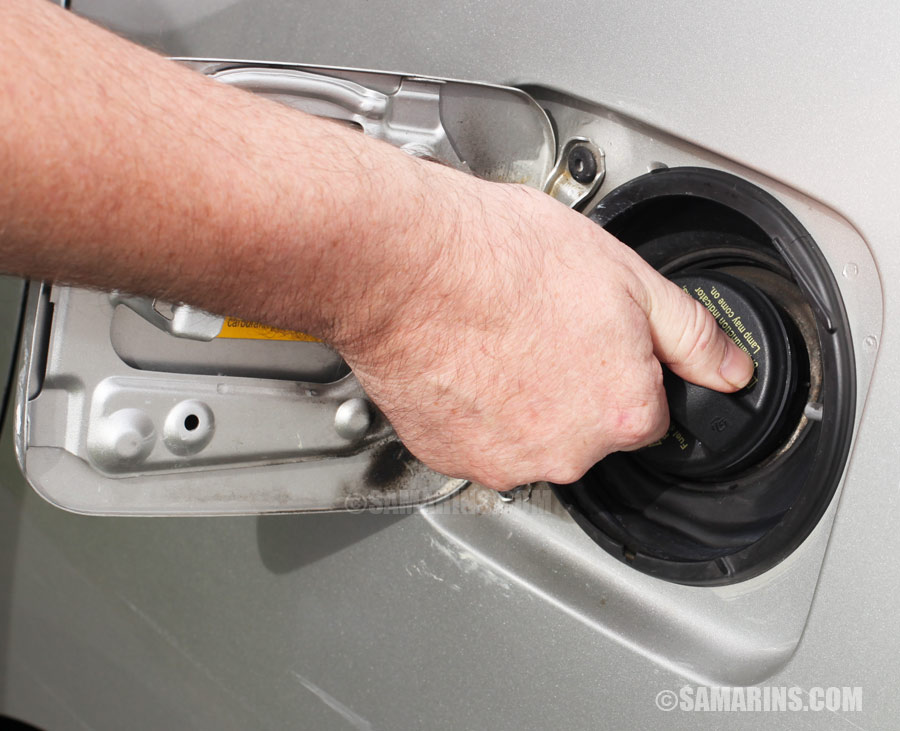 Check if your gas cap is tight
If you do find that the gas cap wasn't tight, close it properly and the Check Engine light will reset itself after a day or two of driving. If the gas cap is tight, there is some other problem that needs to be diagnosed.
If you are comfortable doing basic checks under the hood, there are several more things you can check. Read more in the paragraph below: What to check first if the Check Engine light came on.
Repair Process
To diagnose the problem, the first step is to scan your vehicle for trouble codes. The code points to the problem that caused the Check Engine light to come on. You can take your car to a dealer or your trusted repair shop. Typically they charge a flat diagnostic fee and provide you with a repair estimate once they've done the initial diagnostics.Another option is to have your car scanned at a local parts store; some stores can scan your car for free, read below. However, the trouble code itself doesn't tell exactly which part is bad, but it points to the system or sensor that doesn't work properly. For example, the trouble code P0302 means that the cylinder number 2 misfires, but it doesn't tell why.
Your mechanic will have to do further diagnosis to find the part that is bad. Once the problem is diagnosed and you get the repair quote, you can decide on repair options.
Check Engine Light Repair Options:
1. Brand Dealerships
Technicians working at a dealership receive training from a manufacturer and are familiar with common problems in their cars. They have up-to-date repair information and proper testing equipment, as well as the technical support.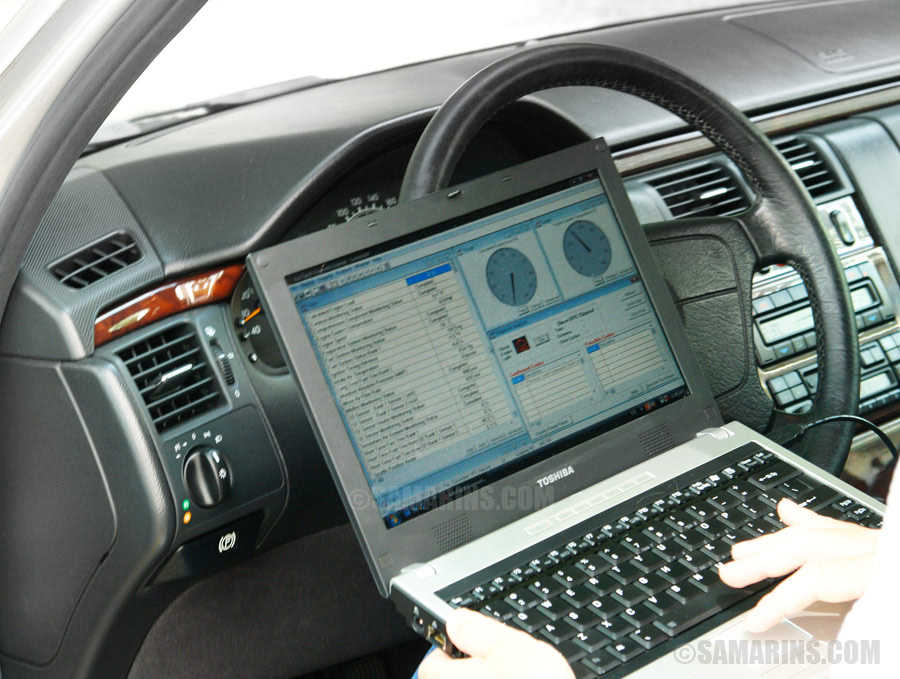 Technician scanning a car
It also might be a good idea to visit your dealer if your warranty has expired recently. In some cases, manufacturers extend the warranty coverage for certain problems, but they don't advertize this information. If you are a regular customer, or if it's a known problem, your dealer can apply to the manufacturer for 'goodwill' warranty coverage. We know of many cases when manufacturers covered the full or partial cost of certain repairs in cars that are recently gone out of warranty. On the downside, out-of-warranty repairs at a dealership tend to be expensive.
Tip: You might be able to save more if you scan for the code in advance (see below where you can scan the trouble code for free) and do some searching for service bulletins (TSBs) related to this code for your vehicle. Service bulletins not only describe the repair for common problems, but provide the info on warranty coverage and labor times to complete the repair.
2. Independent repair shops
Independent repair shops are often less pricey, but a lot depends on the skill level of the mechanic, availability of a proper testing equipment, access to the latest service information and quality of replacement parts. When it comes to "Check engine" light issues, using proper parts can make a difference between a successful repair and repeated problems. Check the shop reviews to have an idea of their technician's skill level.3. Brand-specialized independent repair shops
Another popular option is to take your car to an independent shop or a mechanic that specializes in your vehicle's brand. For example, one of our friends has opened the shop that specialize in German cars and his shop is quite proficient in Check Engine Light issues. Search your area for brand-specific repair shops and get a quote.4. Do it yourself
DIY repairs have never been easier since YouTube became a part of our lives. Thanks to the thousands of automotive enthusiasts sharing their knowledge, there is plenty of how-to videos available.If you have sufficient mechanical skills, proper tools and spare time, once you know the code, it's not that difficult to search for common problems causing that code in your year make and model. There is a good chance that someone has experienced the same code with the same car like yours and posted the how-to video or written a post.
We also posted several articles on some of the most common codes, follow the drop-down menu above. We also described some of the vehicle-specific problems in our Used Car Reviews and Used SUV Reviews.
If you need tools, many parts stores offer to loan tools. Here are a few links:
AutoZone Loan-a-tool.
O'Reilly Auto Parts loaner tool program
Canadian Tire Loan a Tool
How to diagnose a trouble code
1. Check Technical Service Bulletins: To diagnose the Check Engine code, the first step is to check for common known problems. Car manufacturers periodically issue Technical Service Bulletins (TSBs) that describe common problems for certain models. Some TSBs are posted on the internet; Google can help. For example, search for '2014 Jeep Wrangler code P0520 bulletin .pdf' and you will find the Chrysler bulletin in a .pdf format. It says with this code, replace the oil pressure sensor with a revised part. It's a very easy fix.2. Check for common problems posted by owners of the same cars: Again, Google can help. Search for the code + make, model and the year of the car. Check out forums dedicated to your vehicle. The same code in the same car is often caused by the same faulty part.
Try, for example, searching YouTube or Google for "code P0455 2013 Nissan Rogue"; you will see many posts and videos describing the same problem in this vehicle. Read more about the code P0455.
3. Follow the Diagnostic Flow chart in the Service Manual: The factory service manual contains a list of trouble codes and a step-by-step diagnostic procedure for each code. The service manual is written for skilled technicians and may require use of special tools and testing equipment. If you can get access to the factory service manual, you can check for TSBs too. Scroll down to the bottom of this article for a list of websites offering paid access to factory service manuals for different cars.
Where to scan your vehicle for free
If you don't have a scan tool, some auto parts stores and independent auto repair shops offer to scan your car for free, in hopes that you will buy parts or do the repairs at their shop. Here are a couple of links:Pep Boys
O'Reilly Auto Parts Store Services
Google 'free check engine light scan' + ' your town' to find a shop that will scan your car for free. Some dealers and repair shops offer a free Check Engine light scan as a seasonal promotional. The Volvo Service for Life program, for example, includes up to one hour of computer diagnostics. Another option is to ask your friends and relatives. OBD-II scan tools are not very expensive and widely available. Many people have a scan tool in their households these days. There are phone apps that can scan your car too.
How to scan your car for codes if you have a scan tool or phone app:
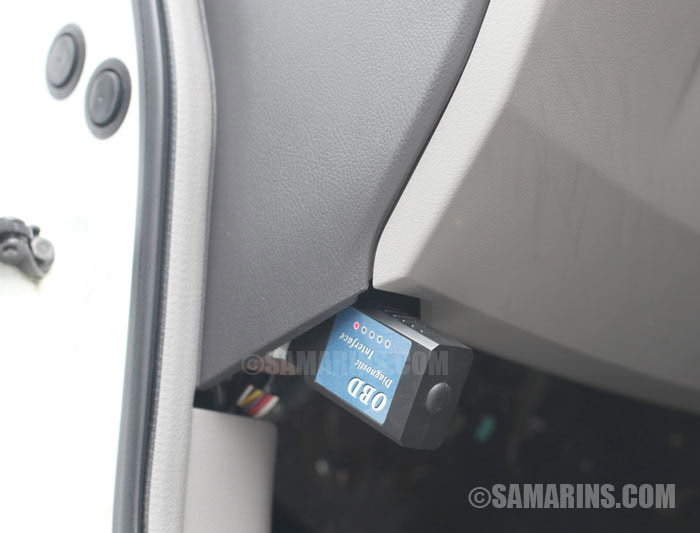
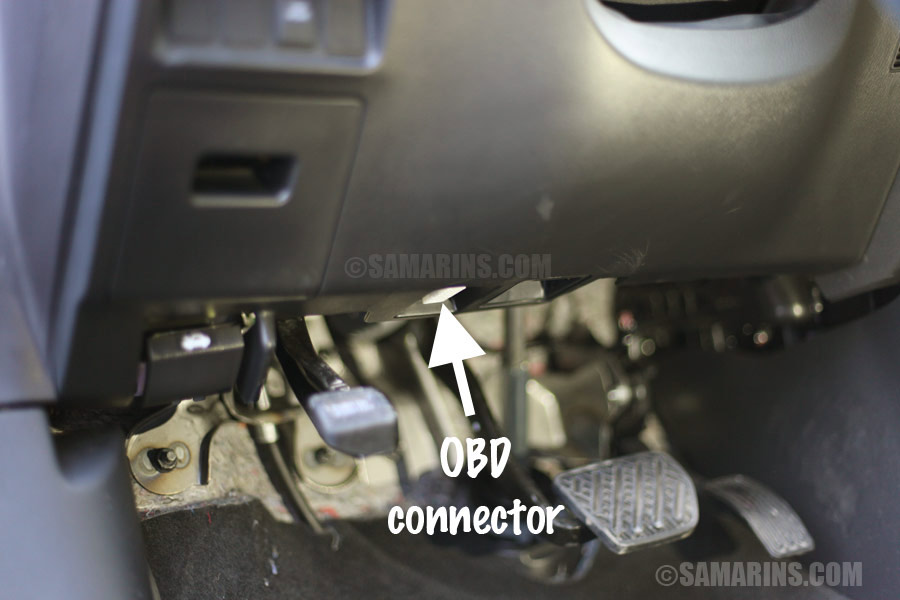
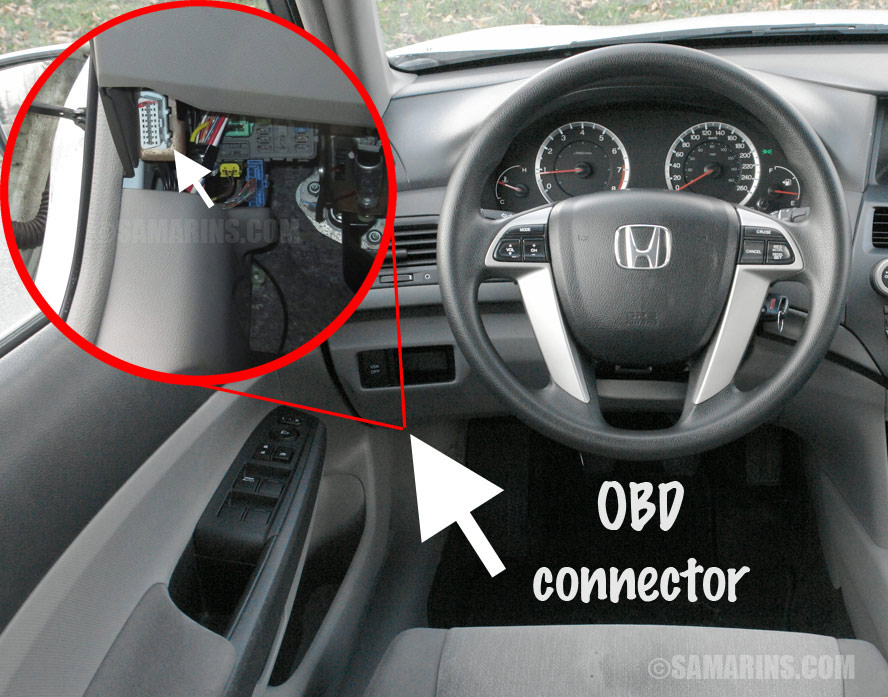
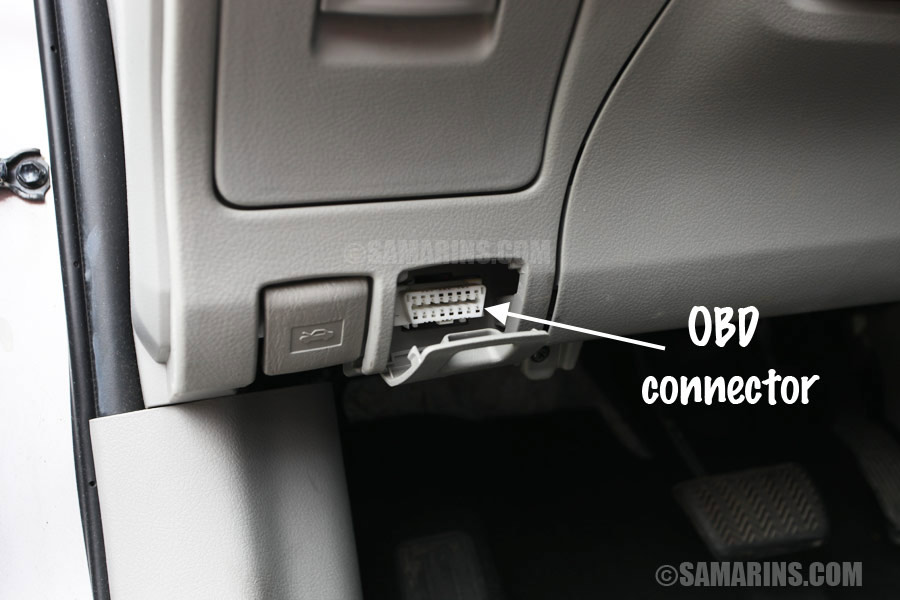 OBD connector
In almost all cars, the OBD diagnostic connector is located at the lower portion of the dash near the driver.
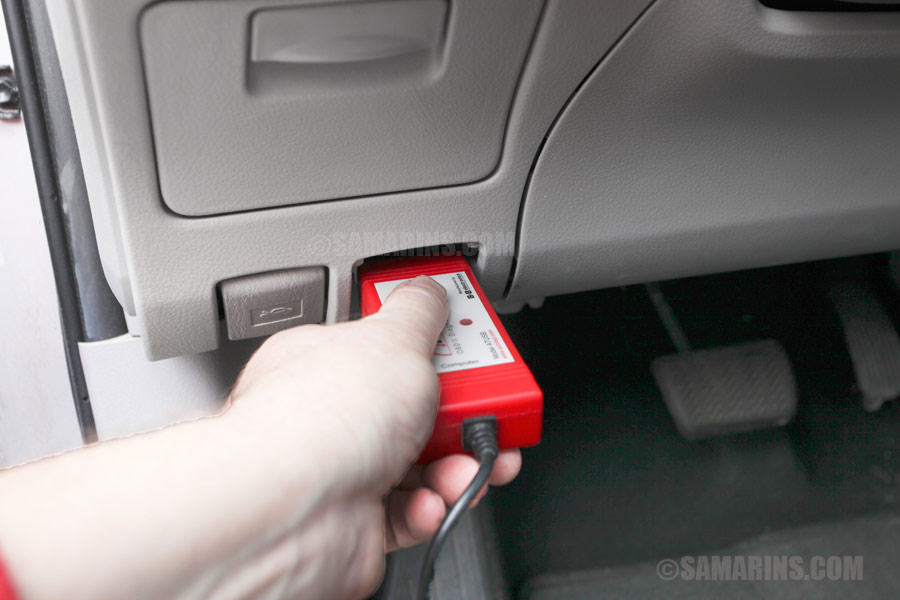 Connect the scan tool to the OBD connector
A basic OBD scan tool can only scan the PCM, which is the main computer in the vehicle. How to scan for codes:
1. With the ignition off, connect the scan tool or a Bluetooth adaptor for the phone app to the OBD connector.
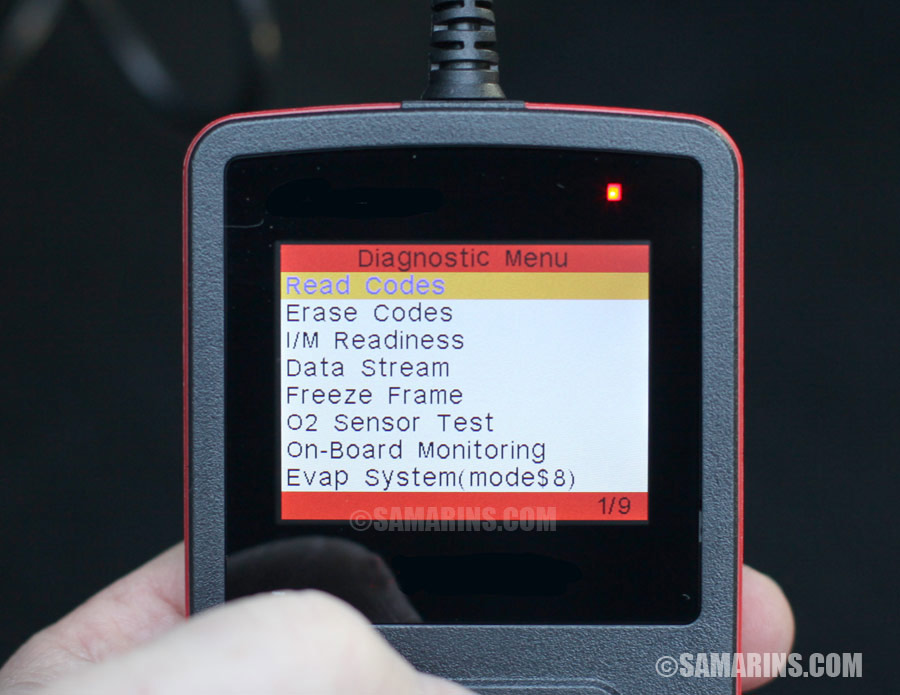 Read trouble codes with a basic scan tool
3. Follow the menus on the scan tool or the app until you get to "Read Stored codes" or "Stored DTCs". If your scan tool can access the freeze frame, check it too; it may help in diagnosing the problem.
Most scan tools also allow you to erase the trouble code, but the code will come back if the problem is still there.
What does the Emission Warranty cover?
The federal emissions warranty covers major components of the emission control system, such as the engine computer (PCM) and the catalytic converter, for the period of 8 years or 80,000 miles (128,000 km in Canada). If your car has trouble codes for a failed catalytic converter (e.g. P0420, P0421, P0430) check the emissions warranty coverage details with your dealer. Read more about the U.S. Emission Warranty.How the engine computer works:
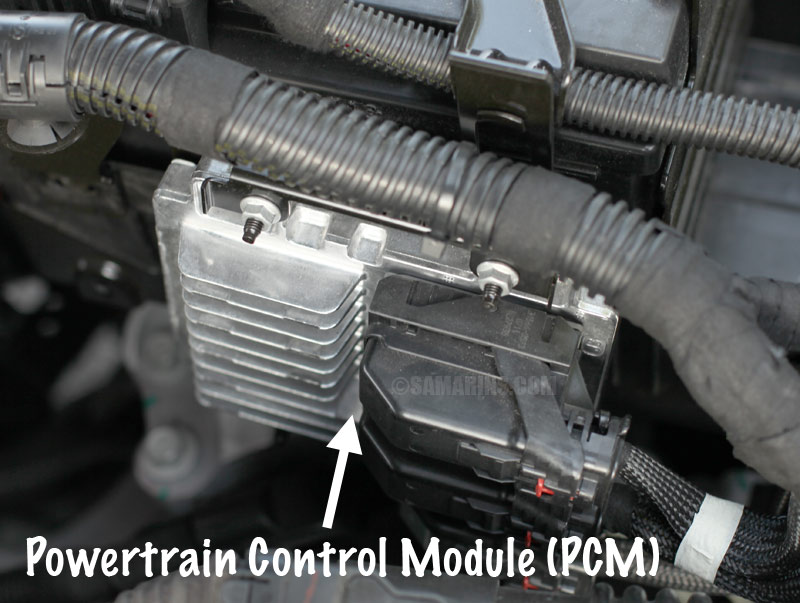 Powertrain Control Module (PCM)
The PCM always tests if all the sensors and emission control systems work as designed. When the PCM detects a fault, for example, when the readings from one of the sensor goes out of expected range, it illuminates the Check Engine light and stores the trouble code in its memory.
What to check first if your Check Engine light came on
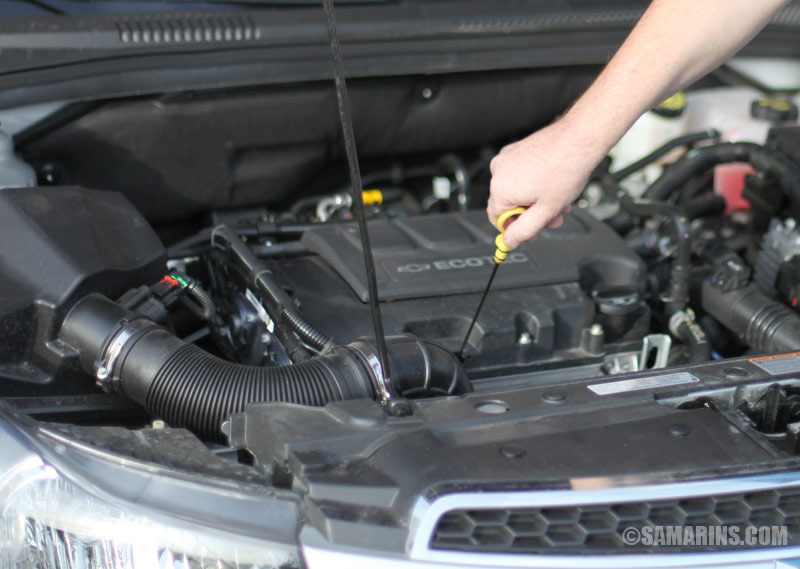 The oil dipstick has a bright handle that says "Engine Oil"
1. Check if you have enough oil in the engine (see how to check the oil level). Low coolant level can cause problems too.
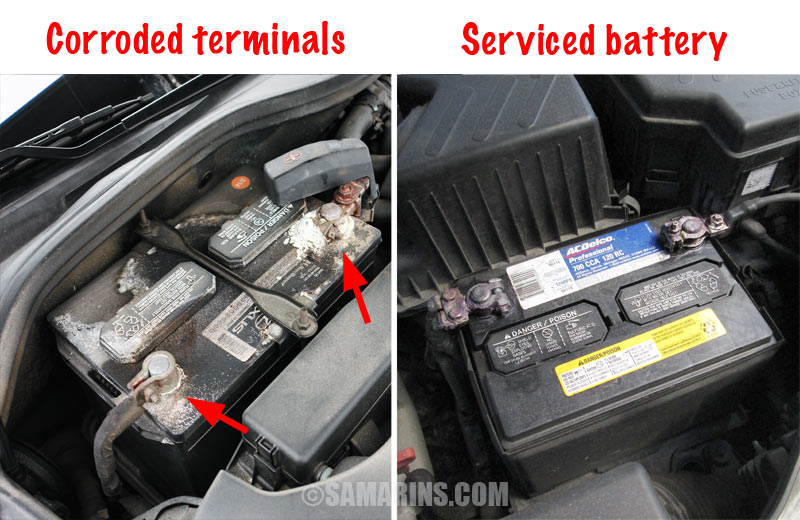
2. Visually check if the battery terminals are tight and not too corroded (see the photo). Loose battery terminals can cause the Check Engine light with 'low voltage' trouble codes.
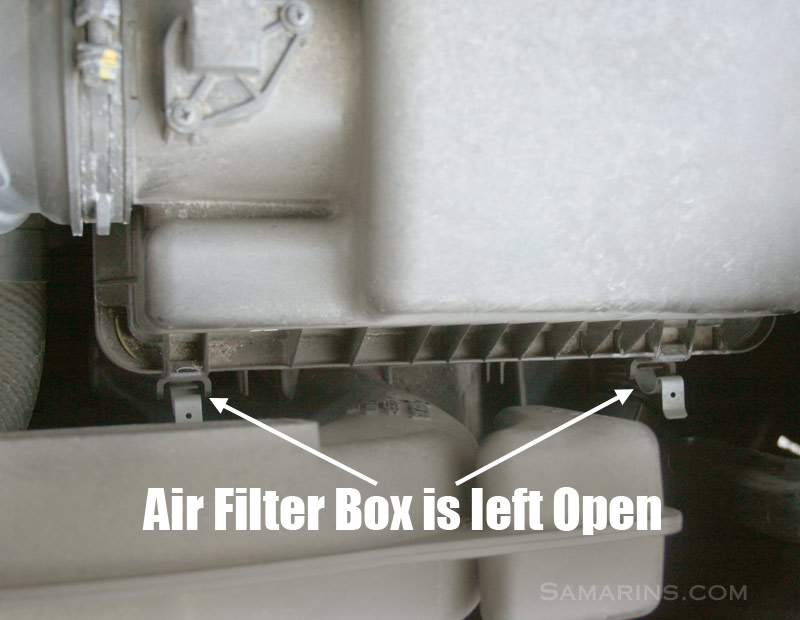
3. Check if the air filter box is not left open accidentally (see the photo); we see it happens quite often causing codes P0100, P0101 or P0102.
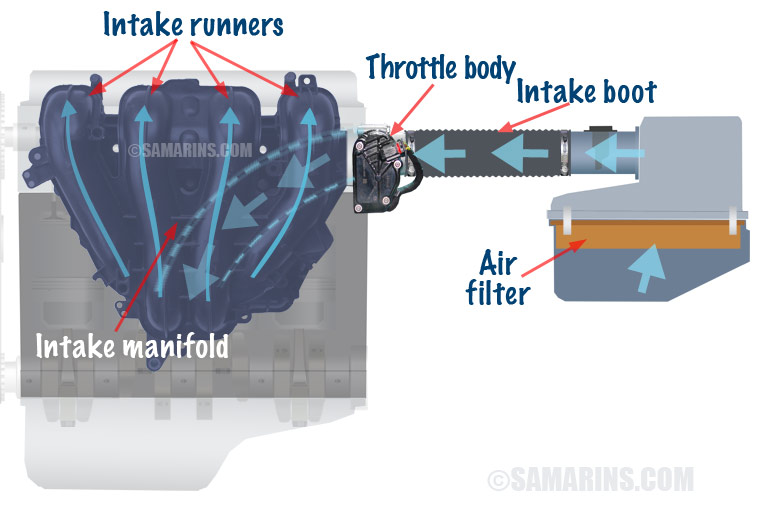
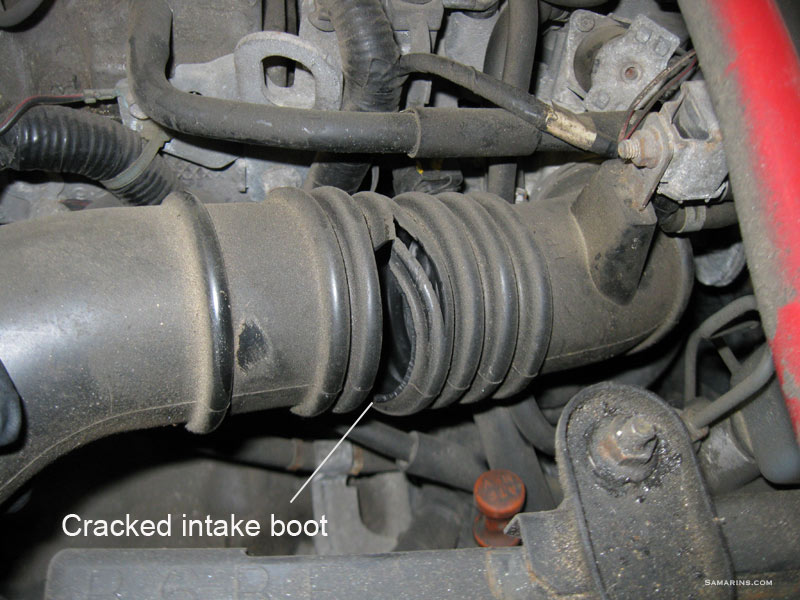
4. Visually check if the intake boot that connects the air filter box to the intake manifold is not cracked/ripped (photo), which is very common problem we see in high-mileage cars. You might feel a lack of power when this happens.
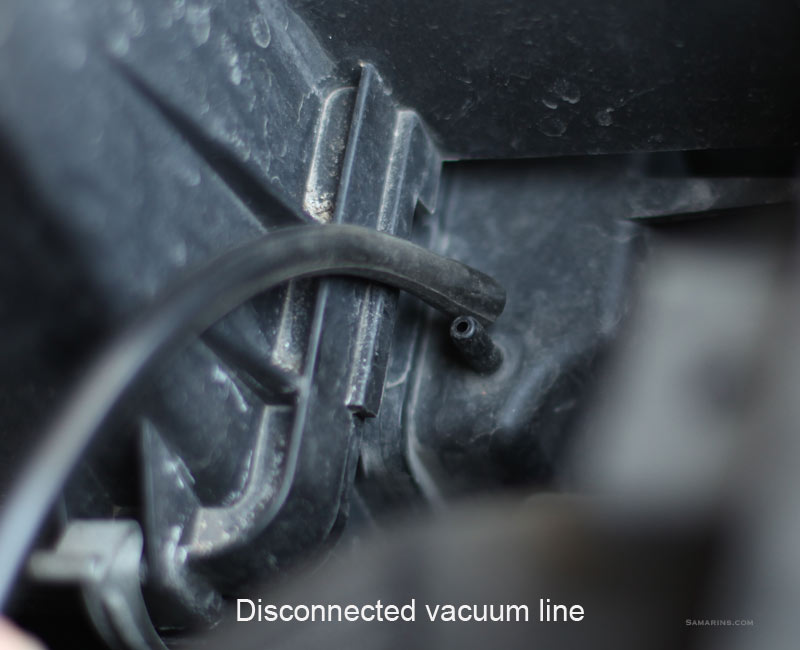
5. Visually check if some electrical connectors or vacuum hoses appear to be loose or disconnected under the hood (photo).
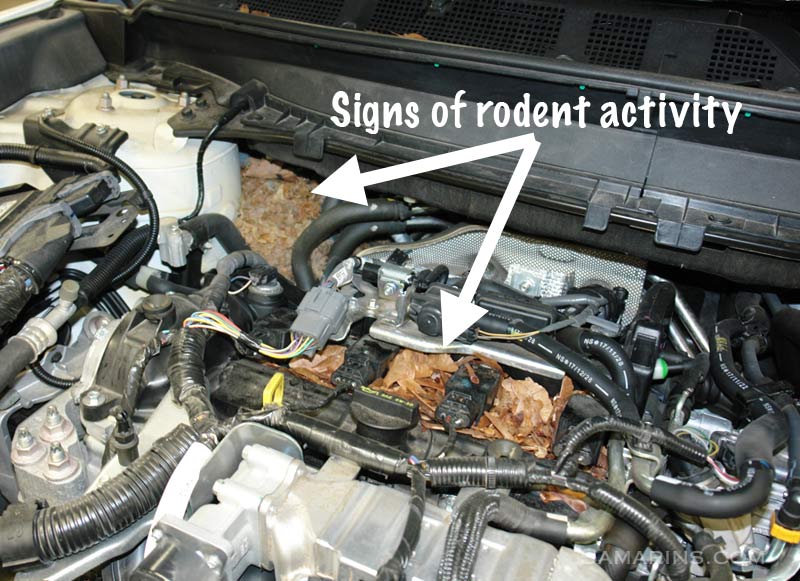
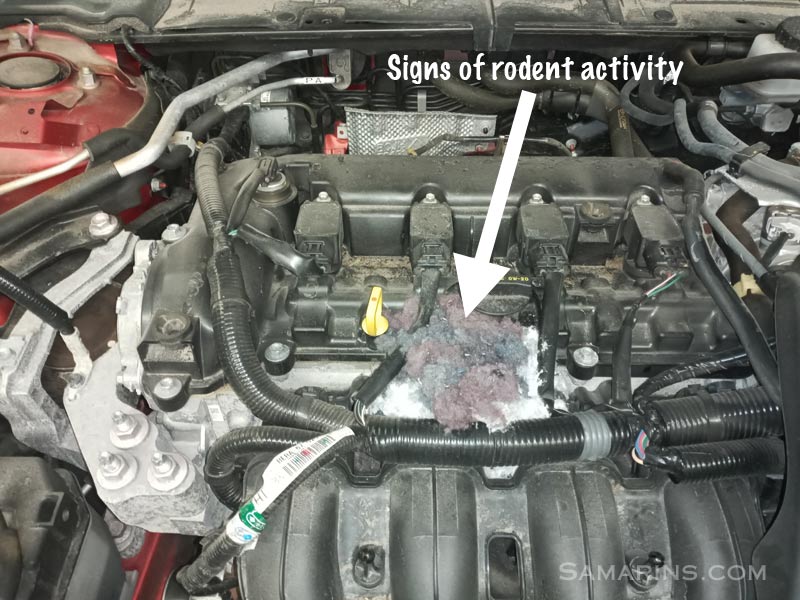
6. If you notice signs of rodent activity in the engine bay (see the photo1 and photo2), one thing they often do is chewing on some wires and that is another possible cause for the Check Engine light we see quite often.
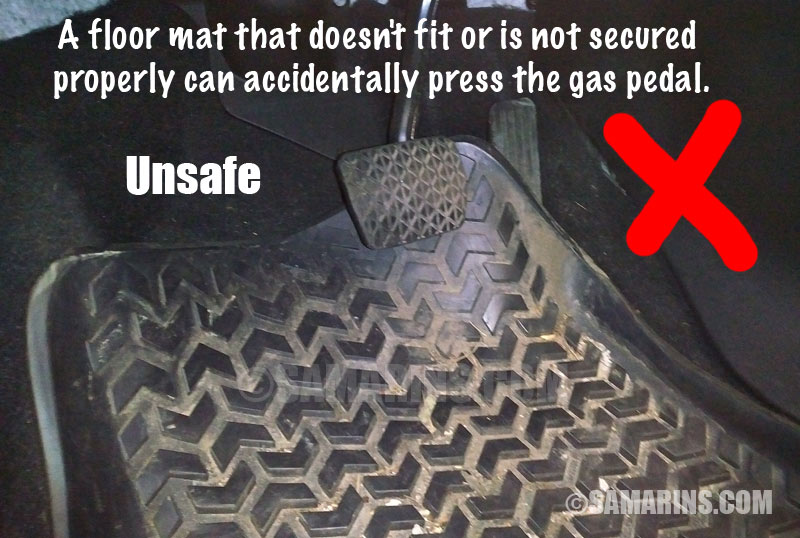
7. Another problem that can cause the light to come on is the driver's floor mat. If the floor mat doesn't fit or is not secured properly, it might accidentally push the gas pedal when pressing the brake and this also could trigger the Check Engine light in some cars.
Is it safe to drive with the "Check Engine" light on?
It really depends on what the problem is. Only your mechanic can tell you this after at least some initial diagnosis. It could be something minor, like a loose gas cap or low battery voltage, but it could also be a more serious issue that could cause more damage to your vehicle. In worst cases, the car may stall or lose power. We recommend having your car checked out as soon as possible to be on the safe side.Why is the Check Engine light blinking on and off?
If the Check Engine light is blinking repeatedly, it means that the engine computer has detected that your engine is misfiring, which means that some of the engine cylinders are not working properly. Driving with a misfiring engine could damage your catalytic converter, which is a very expensive part. Check your owner's manual; it will probably suggest to reduce power and have your vehicle serviced immediately by your authorized dealer. Read more about the symptoms of a misfiring engine: Code P030X - cylinder misfire.Q: Will disconnecting the battery reset the "Check Engine" light?
A: Disconnecting the battery may reset the Check Engine light in most cars, but the light will come back if the problem is not repaired. Also, the readiness code will be erased, which may prevent your car from completing an OBD-II emissions test. The readiness code is an indication that certain emission control components of your car have been self-tested.Q: How long does a car need to be driven before it will be ready for an OBD-II emission test?
A: After the vehicle's battery has been disconnected or the Check Engine code has been cleared, a vehicle needs to be driven before it will be ready for the OBD-II inspection (emission test). Typically it takes at least 40-60 minutes of driving, including 20-30 minutes of steady highway cruising, for your car to be ready for an emissions test. In some cases, it may take a day or two of driving. This is because it takes some time for all components of your car's OBD-II emission control system to perform self-tests.Q: How long does it take for the Check Engine light to reset if the problem is repaired?
A: If the problem that caused the Check Engine light is repaired, the warning light will turn off. For some faults, it may only require re-starting the engine. For other problems, it may take a few trips. It takes time for the car OBD-II system to re-test all the components. If the Check Engine light stays on after a couple of days of driving, the problem is still there.Q: Can overfilling the gas tank cause Check Engine light to come on?
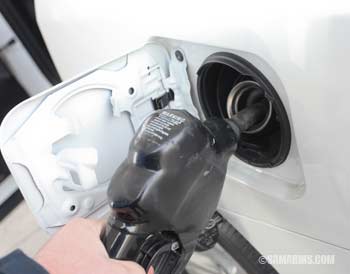 Fill up until the first click
When we overfill the gas tank, the excess gasoline can enter the part of the Evaporative System called the charcoal canister, which is designed to absorb gasoline vapors rather than raw fuel. This can cause problems with the evaporative system and trigger the Check Engine light. The reason manufacturers recommend filling up until the first click is to leave some space in the fuel tank for fuel to expand.
Tips to prevent the Check Engine light from coming on
• Don't overfill the fuel tank. Fill up until the first click of the pump. Check your owner's manual. After filling up, make sure the gas cap is tight and the gas cap strap does not get caught under the cap.• Change engine oil regularly and check the oil level between the oil changes. Top up as needed. Many Check Engine light problems stem from a lack of regular oil changes or driving with a low oil level.
• After checking or replacing the air filter, make sure it's installed properly. If unfiltered air is allowed into the engine, it can damage the vehicle's mass airflow (MAF) sensor. It's best to use OEM or known good quality air filters.
• Lack of tune-ups is another common reason for the Check Engine light to come on. Old spark plugs, dirty throttle body and bad ignition wires can cause many problems.
•If your splash shield under the engine bay is broken or missing, replace it, as it protects the engine bay components and wiring from corrosion.
•Watch out for signs of animal activity under the hood, as the rodents are known to chew on wires and cause Check Engine light.
• When doing repairs, use original parts when possible. Sometimes the Check Engine light comes on because some aftermarket parts like oxygen sensors, mass airflow sensors or catalytic converters can have compatibility issues.
Websites offering paid access to Service/ Repair Manuals
Most of the car manufacturers offer a paid subscription-based access to their service manuals. Many offer a 1- or 3-day access for a reasonable fee.BMW Technical Information System
ACDelco Technical Delivery System is General Motors' service information
Honda Independent Repair Website - available subscription terms: 1 day, 30 days, 365 days.
Nissan Publications
Mazda Service Info
Subaru Technical Information System
Toyota Technical information system
Volvo Technical and Owner bookstore
HelmInc.com Ford, Honda / Acura Service manuals online, CD/DVD service manuals for many brands.
These two websites offer monthly and yearly subscriptions to service manuals adopted for DIY use:
ALLDATAdiy Paid online access to TSBs and DIY service manuals for many brands
Mitchell1DIY Paid online access. TSBs and DIY service manuals.
AutoZone - some free repair guides and technical information is available for registered users. Follow the menu 'Repair Help' then select 'Vehicle Repair Guide'. If you want to find the information on testing of various sensors, follow the menu 'Engine Performance & Emission Controls'.
Read Next:
How to check fuses in a car
Purge valve (solenoid): how it works, symptoms, problems, testing
Code P0128 - Coolant Temperature Below Thermostat Regulating Temperature
Code P0171 - System Too Lean
Misfire codes P0301-P0308
OBD II code P0401 Exhaust EGR Flow Insufficient
Code P0455 Evaporative Emission Control System Leak Detected (gross or large leak)
How to check fuses in a car
Purge valve (solenoid): how it works, symptoms, problems, testing
Code P0128 - Coolant Temperature Below Thermostat Regulating Temperature
Code P0171 - System Too Lean
Misfire codes P0301-P0308
OBD II code P0401 Exhaust EGR Flow Insufficient
Code P0455 Evaporative Emission Control System Leak Detected (gross or large leak)
 © Samarins.com 2000–2025. All rights reserved.