Toyota Camry 2007-2011: pros and cons, common problems
By Vlad Samarin. Updated: April 09, 2023
The Toyota Camry offers a roomy, comfortable interior and smooth and quiet ride. The 2007-2011 model (XV40) has front-wheel drive and comes only as a 4-door sedan; the Camry Solara coupe has been discontinued after 2008.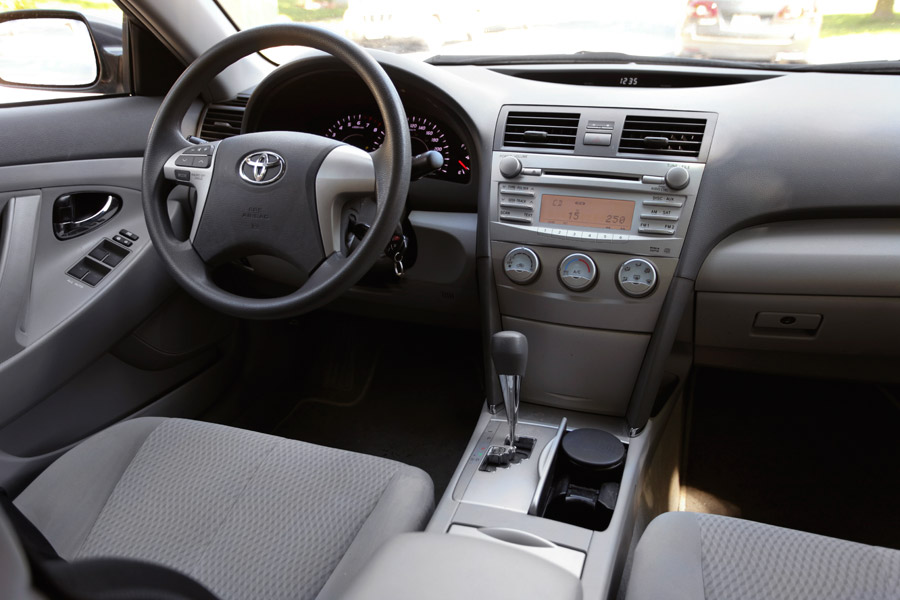 Toyota Camry interior.
The Camry has a 4-cylinder or V6 engine. Trim levels include the Base (CE or Camry), the most popular LE, sporty SE and top-of-the-line XLE as well as a Hybrid. The SE offers 17-inch wheels and a firmer suspension. The 2007-2010 Camry Hybrid delivers 34 mpg combined.
The Toyota Camry has a reputation of being a dependable car, although some model years had more reported problems than others and should be avoided. With good care, this car can last well past 200,000 miles, but there are a few trouble spots to watch out for.
Pros:
- Dependable.
- Fuel economy.
- Strong V6.
- Smooth and quiet ride.
- Spacious interior.
- Crash test ratings.
- Holds value well.
- Conservative styling.
- Oil consumption issues.
- Interior materials could be better.
Another trouble spot is the oil consumption and hesitation on acceleration of the 4-cylinder 2AZ-FE engine in the 2007-2009 Camry. There are also quite a few complaints about a failed driver's sun visor and 'melted' or cracked dashboard in regions with hot climate. The 2010-2011 Camry received fewer complaints and is a better choice.
Oil Consumption: Toyota has issued the Warranty Enhancement Program ZE7 to address issues with excessive oil consumption in some 2007-2009 Camry models with the 2AZ 4-cylinder engine. As we know from people working for Toyota dealers, many cars have been repaired under this warranty program.
For people buying a used 2007-2009 4-cylinder Toyota Camry, it might be helpful to check with a Toyota dealer if the engine has already been repaired under this program.
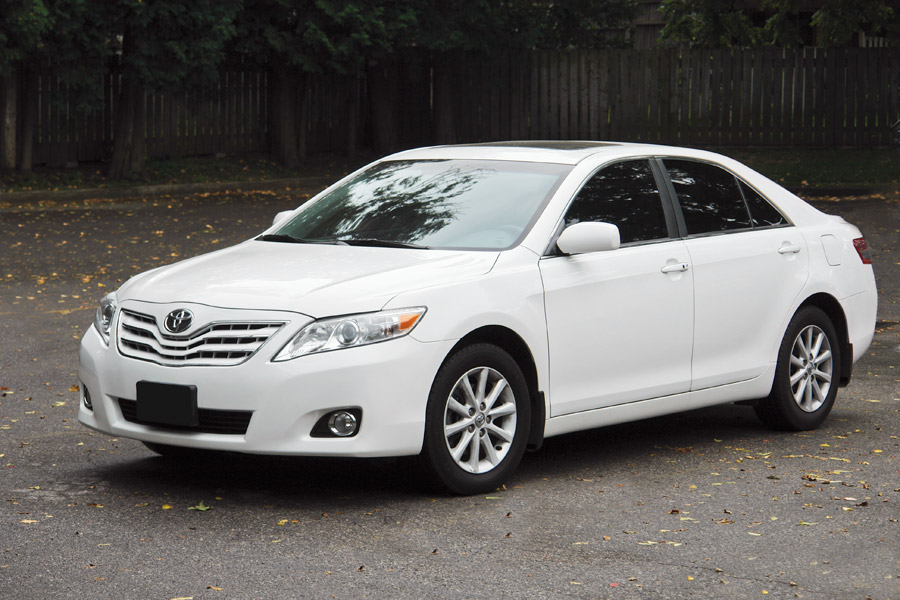 2011 Toyota Camry
One telltale sign could be a short hesitation when accelerating after coasting or from a stop. Of course, a blue smoke from exhaust, low oil level or the engine running rough when started are the obvious signs.
Excessive oil consumption is quite common for many other cars. We know people who simply check the oil level regularly and top up the engine oil as needed instead or repairing the engine.
Advertisement
There have been reports about the water pump failing. Symptoms of a bad water pump include coolant leak and pinkish residue around the drive belt area and abnormal noises from the water pump.
Replacing a water pump in a 4-cylinder engine requires 1.8-2.1 hours of labor while the same job in a V6 engine will be 4-5 hours of labor. The part is not very expensive.
Considering that water pump failures and coolant leaks from the radiator and other parts are fairly common, it's a good idea to keep an eye on the coolant level in the expansion reservoir under the hood.
A low coolant level can cause overheating of the engine and expensive repairs. If the coolant level looks very low, have the vehicle checked for coolant leaks before it causes problems.
The code P0138 is often caused by a bad rear or downstream oxygen sensor. Replacing the rear O2 sensor is not very difficult (0.5 - 0.7 hours of labor). Watch these videos if you want to know how it's replaced. The part is from $40 to $60 for an aftermarket sensor to around $250 for an OEM part.
In a V6 engine, a failed ignition coil can cause the Check Engine light with the codes P0351-P0356.
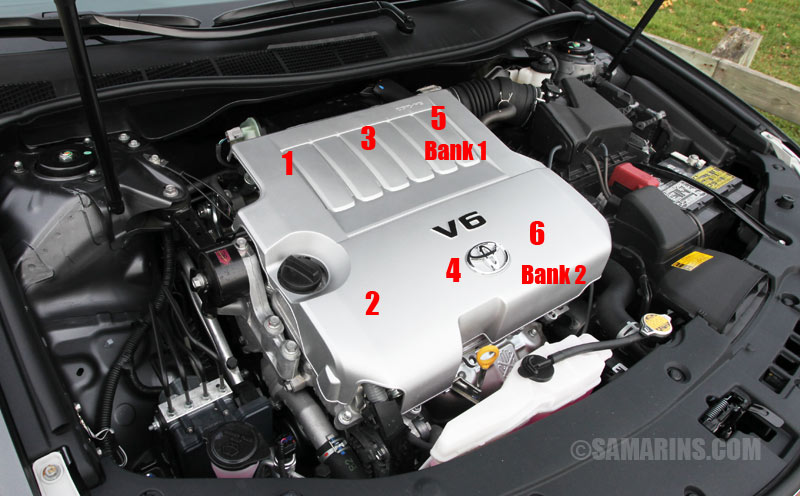 Toyota 2GR-FE V6 engine banks and cylinder numbers
Replacing front coils 2, 4 and 6 is easy, while replacing any of the rear ignition coils takes 2.4 hours of labor because the intake manifold has to be removed to get access.
Ignition coils can also fail in the 4-cylinder engine, but they are easy to replace. When replacing one ignition coil, it's also a good idea to replace all the spark plugs if they are old at the same time. Normally, spark plugs need to be changed at 120,000 miles.
A failed strut can cause a clunking noise when driving over bumps, even though a strut may visually appear OK. Replacing a pair of struts costs $550-$750. The wheel alignment might need to be done after struts have been replaced.
Warped rotors can cause the steering wheel to shake during braking at high speed. Bad rotors will need to be machined or replaced to repair the problem.
Many owners have mentioned that sun visors are breaking off. Aftermarket parts are available online for $20-$40; the OEM part is still under $100. Replacing a sun visor is easy; watch these videos on the repair.
Exhaust leaks from the flex pipe and other areas are fairly common at higher mileage. The Toyota OEM exhaust parts are not cheap. We recommend to check with a local muffler shop. Often they can weld or fabricate the part on the spot for much cheaper price.
2007-2011 Toyota Camry Engines: The 2007-2009 4-cylinder Camry comes with a 158-hp 2.4L DOHC motor (2AZ-FE) carried over from the previous generation. It's a pretty good motor, but there have been complaints about oil consumption. Check the oil level regularly and top up if needed.
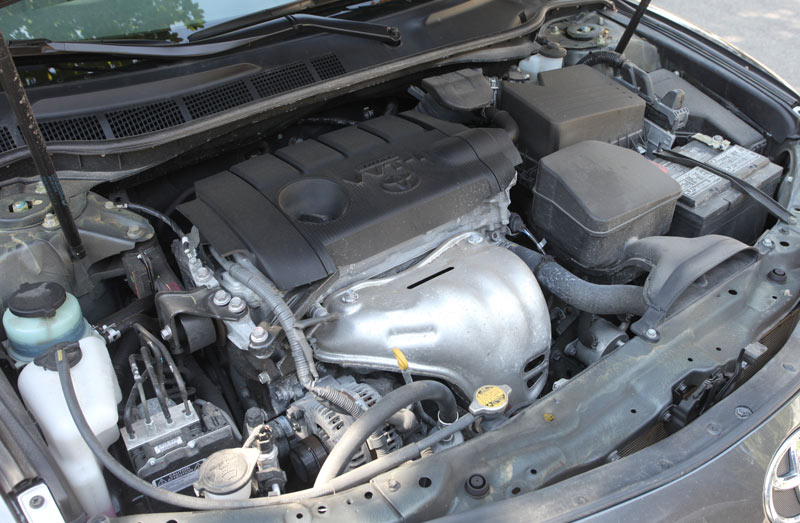 2011 Toyota Camry 2AR-FE engine.
The optional 268-hp 3.5L V6 (2GR-FE) is smooth and has plenty of power. It's bulletproof reliable and can last long with good maintenance.
Timing belt or chain: Both 4-cylinder engines and the V6 have a timing chain; there is no timing belt.
Transmission choices: A manual transmission is only available in 4-cylinder models. The 2007-2009 4-cylinder Camry has a 5-speed automatic. The V6 models, as well as the 2010-2011 4-cylinder Camry come with a 6-speed automatic transmission.
Fuel Economy: The 4-cylinder Camry is good on gas and the V6 Camry is one of the most fuel efficient V6 sedans. With mostly highway driving, the 2010-2011 4-cylinder automatic Camry can drive up to 483 miles (777 km) on a 18.5-gallon (70 L) tank. See EPA fuel economy numbers in the table.
| Toyota Camry EPA fuel economy: | mpg city/hwy |
L/100 km city/hwy |
| 2007-2010 Hybrid | 33/34 | 7.1/6.9 |
| 2011 Hybrid | 31/35 | 7.6/6.7 |
| 2007-2009 4-cyl, manual | 21/31 | 11.2/7.6 |
| 2007 4-cyl, auto | 21/30 | 11.2/7.8 |
| 2008, 2009 4-cyl, auto | 21/31 | 11.2/7.6 |
| 2010, 2011 4-cyl, manual | 22/33 | 10.7/7.1 |
| 2010, 2011 4-cyl, auto | 22/32 | 10.7/7.4 |
| 2007-2010 V6, auto | 19/28 | 12.4/8.4 |
| 2011 V6, auto | 20/29 | 11.8/8.1 |
Handling and Ride: The Camry is easy to drive. It's responsive and smooth. The ride is soft; road imperfections are well absorbed by the suspension.
Interior: Inside the Camry is very roomy. The front seats are large and comfortable. The steering tilts and telescopes. Controls are easy to use.
Rear seat space tops most of the competitors. The split rear seat folds in all but Camry SE and Hybrid, although the pass-through opening between to the trunk is rather small. The Camry XLE has a manually reclining rear seat with a center pass-through. The trunk is huge.
2007-2011 Toyota Camry: Is it a good car to buy? Toyota's success is based on advancing in small steady steps, building on what worked in previous models. Mechanically, this generation Camry is not much different from the previous model, but this is what makes it so reliable.
As of June 2022, Consumer Reports rates all model years of this generation Toyota Camry as "Recommended." The overall reliability is rated 'above average' or 'far above average'. The 2010 and 2011 Camry have received fewer complaints and have a better 2.5L 4-cylinder engine. The V6 Camry is not only fast, but super-reliable. Overall, it's one of the best mid-size sedans on the market.
We talked to several people who had this model Camry and they were very happy with the vehicle. Competitors include Nissan Altima, Mazda 6, Chevrolet Malibu, Ford Fusion and, of course, Honda Accord. The more sporty Altima offers better city gas mileage thanks to its continuously variable transmission, but it's not as roomy. The Honda Accord provides a better road feel. The Mazda 6 handles better, but lacks in fuel economy.
Related reviews:
Toyota Camry 2002-2006
Toyota Camry 2012-2017
Toyota Corolla 1998-2008
Toyota Corolla 2009-2013
Toyota RAV4 2006-2012
Nissan Altima 2007-2012
BMW 3-series 2006-2011
Honda Accord 2008-2012
Mazda 6 2009-2013
Toyota RAV4 2013-2018
What to look for when buying a used Toyota Camry: When inspecting a used Toyota Camry, watch out for leaking struts. Check for a low coolant level and coolant leaks. A low oil level might indicate that the engine consumes oil. Watch for any of the warning lights on the dash staying on after the engine is started. Thoroughly test all the electrical features.
Check out the sun visors. During the test drive, see how the automatic transmission shifts. Often transmission problems are evident only after the vehicle has been driven for at least 10 minutes and is fully warmed up.
Lack of power or hesitation when accelerating from a stop was a common complaint for the 2007-2009 4-cylinder Camry; it might be an indication of excessive oil consumption. Watch out for vibration and pedal pulsation during braking. Read more on How to inspect a used car - illustrated guide. Before buying a car, have it properly inspected by a mechanic. Read also: What mileage is OK for a used car?
Toyota Camry Maintenance Tips: Given the oil consumption issues, check the oil level regularly (see how) and top up as needed. Spark plugs need to be replaced at 120,000 miles or earlier. You can find the maintenance schedule in the Warranty and Maintenance Guide that you can download from the Toyota Owner's website.
The engine air filter must be checked at every service and replaced if dirty. The serpentine belt will also need to be replaced when it shows signs of wear. Keep an eye on the coolant level; it's visible in the coolant expansion bottle under the hood.
The transmission fluid needs to be changed if dirty; it's best to use only the original Toyota transmission fluid from the dealer. Servicing brakes at least once a year will prevent issues with the brake calipers seizing.
The car battery might need to be replaced or at least tested after 5 years. Covering the windshield with a sun shade when the vehicle is parked may prevent heat damage to the dashboard. We recommend having the vehicle suspension, brakes and other components inspected in a repair shop at least once a year to keep it safe.
Engine oil capacity: With oil filter change:
2.4L 4−cylinder (2AZ−FE) engine: 4.5 US qt. (4.3 liters). The recommended oil grade is 0W-20 (preferred) or 5W-20 oil.
2.5L 4-cylinder (2AR-FE) engine: 4.7 US qt. (4.4 liters). Oil grade: 0W-20
3.5L V6 (2GR-FE) engine: 6.4 US qt. (6.1 liters). SAE 5W−30 is the recommended oil grade.


 © Samarins.com 2000–2024. All rights reserved.